Enhancements
Ideas for modifying a rampaging chariot
The rampaging chariots guild created the rampaging chariots that you have built to interest you in engineering. Now it is your turn to engineer some modifications of your own!
If you are unsure about anything in this guide, or you have an idea for your own modification but are unsure if it would be allowed then please contact the guild. Any modifications that are judged to be unsafe on competition day will not be allowed so please avoid disappointment and get in contact. Don’t worry; we won’t pass your ideas onto other teams.
Remember the most important thing is to have fun!
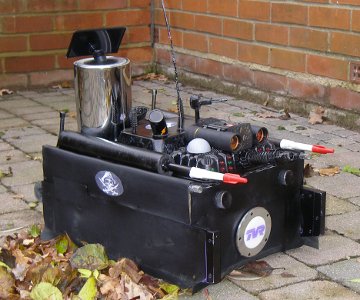
Basic improvements
Create a lid for your chariot to improve its looks in competition
Could you make your robot have an interesting theme?
Could this be based on something special to your school, ATC Sqn or club?
What materials will you use?
How will you make sure that the removable links can still be accessed quickly without the need for tools?
Estimated cost: Materials - £10
Create a fixed scoop to allow other robots to be lifted up
Can a scoop be added to the front of the chassis without drastically modifying the chassis design?
What materials should the scoop be made from?
Should the scoop be flat, curved or two or more large forks?
What are the advantages of each design?
How best to implement the design?
Estimated cost: Materials - £10
Prevent the robot running out of power during competitions
Replace the cordless drill batteries with sealed lead acid gel accumulators
Buy a 12 volt battery and a 6 volt battery of about 7 Ah that can supply a reasonable current. Note security system batteries are generally not suitable. We recommend Rapid Electronics part numbers 18-1104 @ £20.70 and 18-1100 @ £13.70
How are you going to fix the batteries to the chassis as they are quite heavy?
How are you going to connect two boards to one battery including a safety plug/link?
How are you going to charge the batteries?
How are you going to fit a safety fuse? We recommend a 20A spade fuse.
Estimated cost: Materials - £ 35
Intermediate improvements
Modify the shape of the chassis to allow it to be better suited to the competitions
What are important attributes that a robot must have to win a competition at the Scottish Robotic games?
Look at various different shapes. What are the advantages and disadvantages of each, i.e. box, wedge, circles, triangles etc?
Once a design is chosen should you make a neat scaled drawing and then make the new chassis out of cardboard to test if the components will fit? Or jump straight in with new materials?
Analyse the new design, is it suitable for the Scottish robotic games? Will it stand up to the rough and tumble of the competitions?
What will you do if the new design has a flaw?
How will you manufacture the design?
Estimated cost: £20 for new materials
Create a passive (unpowered) movable scoop to allow other robots to be lifted up
Can a scoop be added to the front of the chassis without drastically modifying the chassis design?
Look at the football guides, could an axle be run through them with a scoop attached?
What materials should the scoop be made from?
Should the scoop be flat, curved or two or more large forks?
What are the advantages of each design?
How best to implement the design?
Remember the maximum protrusion in front of the main chassis is 50mm
Estimated cost: Materials - £15
Make an LED display on your robot
What makes LEDs special when wiring them up? Hint – positive and negative terminals and safety resistors.
Would you be able to spell out your School initials, ATC unit or club name in LEDs on your robot?
How many LEDs would you require for your design? Remember you don’t have to think huge, a small display can be just as effective.
How would you wire the display into your robot so that the display lights up when you connect your removable link?
Please be aware that any LED displays must not flash or use exceptionally bright LEDs for health and safety reasons.
Estimated cost: LEDs and resistors - £5, Breadboard - £2
Advanced improvements
Convert the Rampaging Chariot to 4 wheel drive
How can you connect the wheels on each side mechanically?
How can you ensure the motors are fixed firmly enough to the chassis so that they transfer power to the other wheel without bending out of line?
Estimated cost: Connection chains/cogs/belts/wheels - £30 depending on method
Make tank tracks to give increased grip
How do tank tracks work and how do they stay on a tank?
How will you make the tracks? For example, pulley belts with a groove carved into the wheels of the chariot, tracks from toy models etc.
What method will you use to design the tracks?
How will you manufacture the tracks and associated parts and what materials will you use?
Estimated cost: Large rubber belts - £15 or Model tracks - £100
Create a powered movable scoop to allow other robots to be lifted up
Note – Any powered scoops MUST follow the rules below or they will not be allowed to compete
The scoop must only be powered by electric means, e.g. a motor attached to a threaded rod to work as a linear actuator. No pneumatics, hydraulics or other methods will be allowed.
The scoop must have a safety break in the circuit to allow the scoop to be completely isolated.
The robot must be fitted with a non flashing LED indicating if the scoop is active.
If you are unsure about your design then please get in contact with the rampaging chariots guild to avoid disappointment at competition time.
Can a scoop be added to the front of the chassis without drastically modifying the chassis design?
Look at the football guides, could an axle be run through them with a scoop attached?
How will you power the scoop?
Research linear actuators, how could you make one and fit it into the robot?
What materials should the scoop be made from?
Should the scoop be flat, curved or two or more large forks?
What are the advantages of each design?
How best to implement the design?
Estimated cost: Raw materials - £15, Drill motor - £10, Threaded rod - £2
|